

2025 Volkswagen Atlas Vs. Toyota Highlander
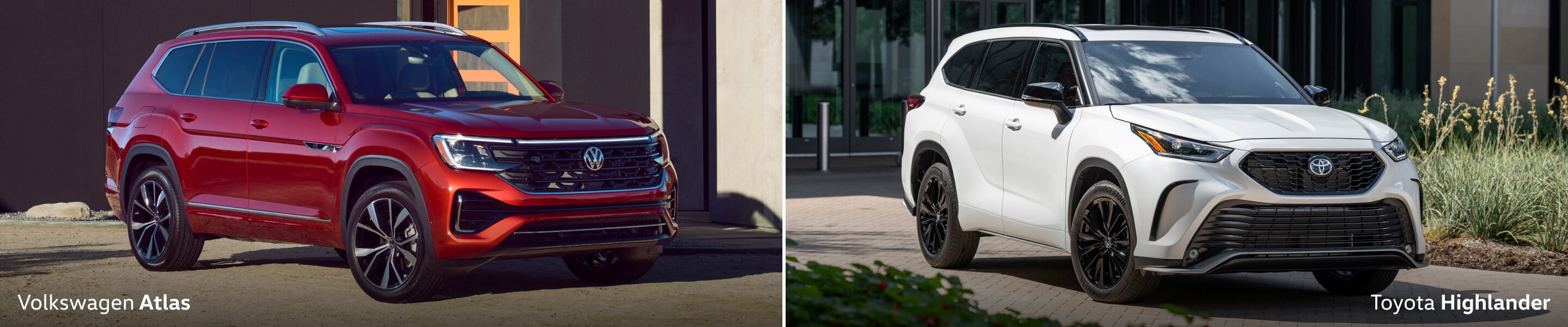
If you're ready to experience a capable and dependable three-row SUV, we invite you to review our Volkswagen Atlas vs. Toyota Highlander comparison to find the right option for you and your family. While the Highlander is a capable model, the Volkswagen Atlas stands out with its unique blend of performance, comfort, and technology. After you've seen how the Atlas pulls ahead to outshine the Highlander, schedule a visit to DARCARS Volkswagen of Fairfax to finance or lease one of your own.
← Drag to scroll →
| 2025 Volkswagen Atlas SE | 2025 Toyota Highlander LE | |
|---|---|---|
| Engine | 2.0L Turbo 4-cyl | 2.4L Turbo 4-cyl |
| Horsepower | 269 | 265 |
| Torque | 273 lb-ft | 310 lb-ft |
| Max Towing Capacity | 5,000 lbs1 | 5,000 lbs2 |
| EPA-Est. MPG (Cty / Hwy / Comb) | 20 / 26 / 223 | 22 / 29 / 252 |
| Fuel Tank Capacity | 18.6 gal | 17.9 gal |
| Length | 200.7 in | 194.9 in |
| Width | 78.3 in | 76 in |
| Height | 70.4 in | 68.1 in |
| Max Passenger Volume | 153.7 cu ft | 141.8 cu ft |
| Max Cargo Space | 96.6 cu ft | 84.3 cu ft |
VW Atlas vs. Toyota Highlander: Trims & Configurations
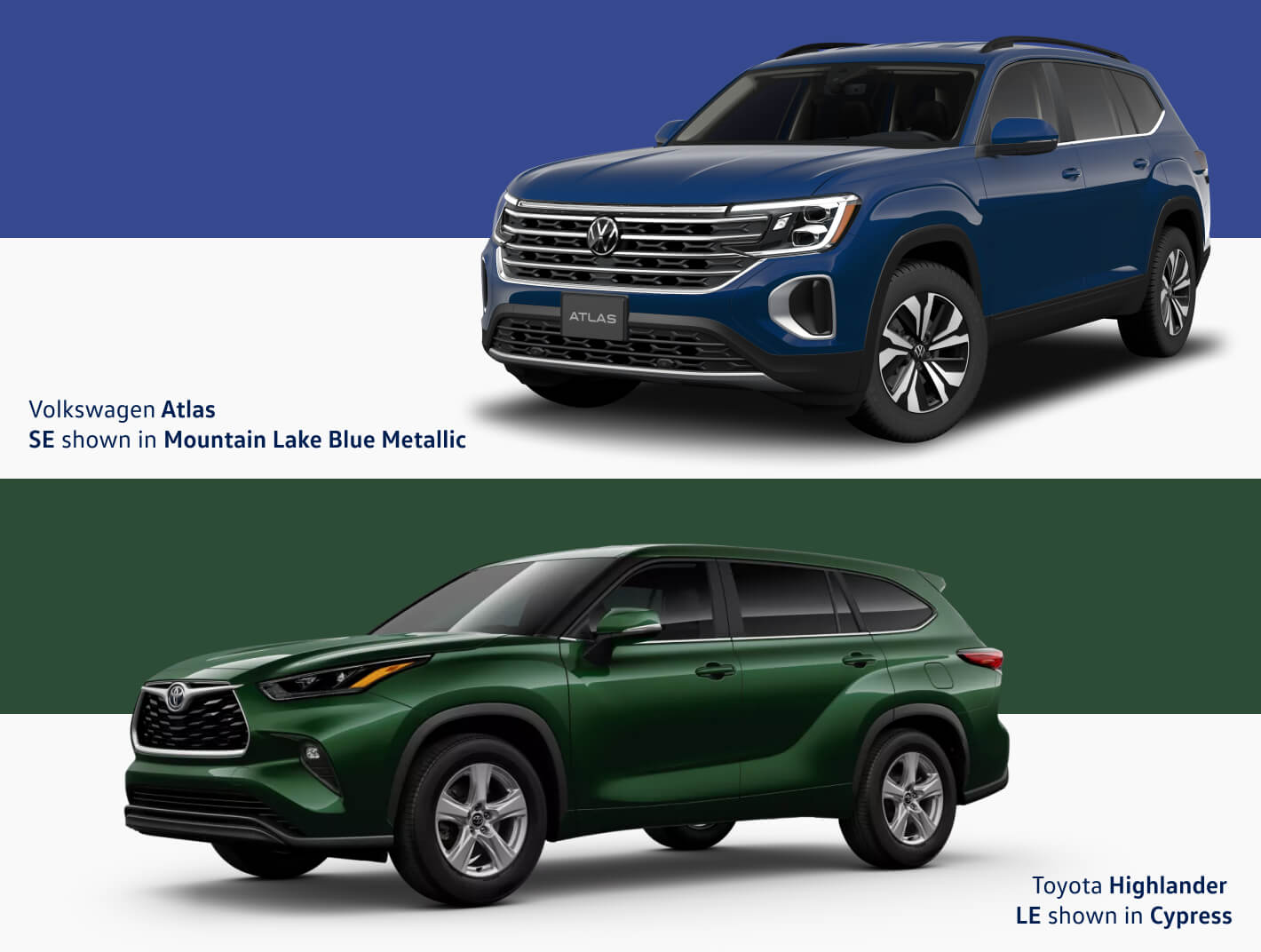
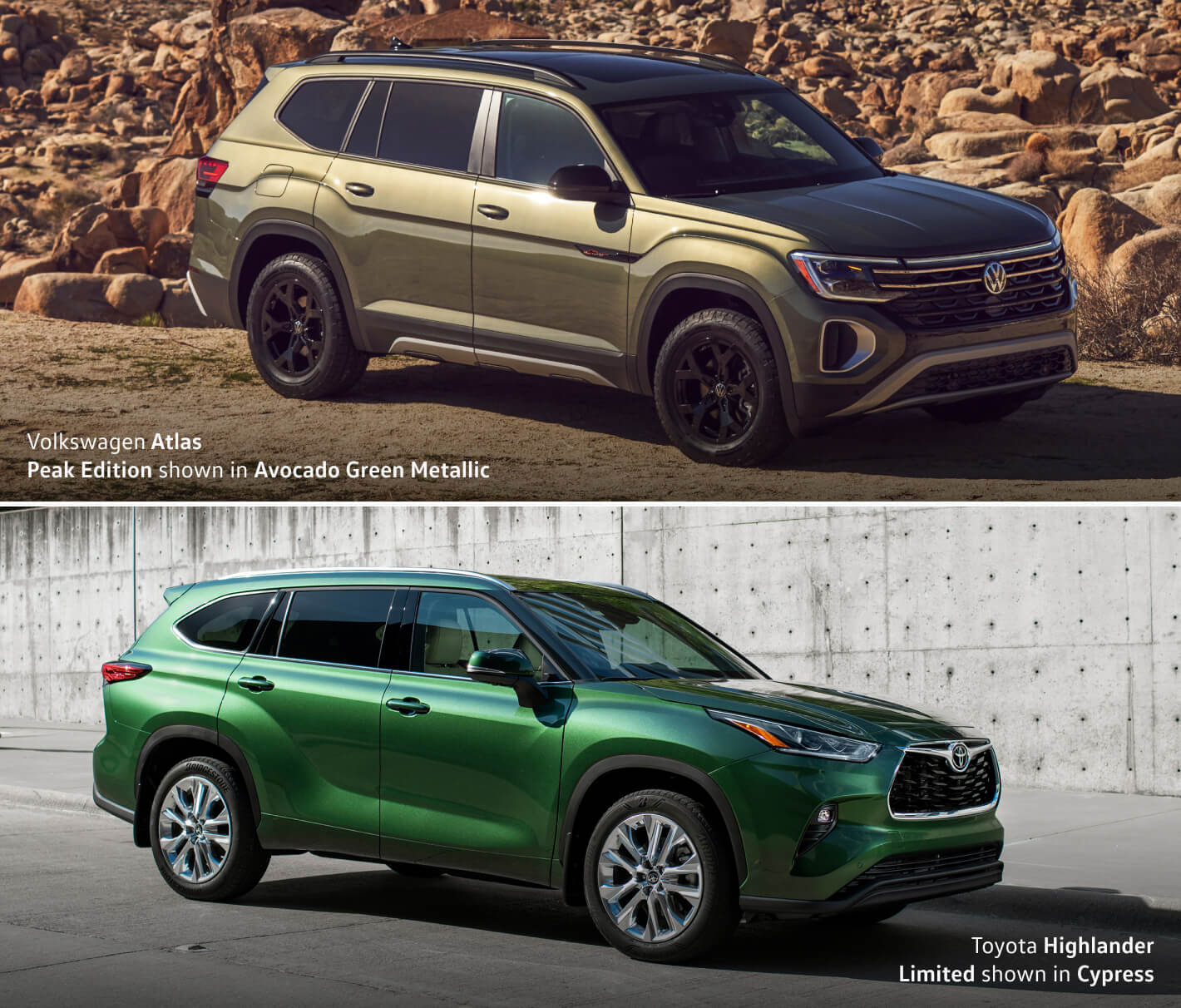
To kick off our comparison of the Volkswagen Atlas vs. Toyota Highlander, let's introduce the different trim levels of these SUVs. The Atlas offers a diverse five-trim lineup, ensuring there's a model for every driver. Choose from the following VW Atlas trims:
- 2025 VW Atlas SE
- 2025 VW Atlas SE with Technology
- 2025 VW Atlas Peak Edition
- 2025 Volkswagen SEL
- 2025 Volkswagen SEL Premium R-Line
The 2025 Toyota Highlander also comes in five versions. Hybrid trims are also available, but we'll stick to these gas-only models for the sake of our comparison:
- 2025 Toyota Highlander LE
- 2025 Toyota Highlander XLE
- 2025 Toyota Highlander XSE
- 2025 Toyota Highlander Limited
- 2025 Toyota Highlander Platinum
2025 Volkswagen Atlas vs. 2025 Toyota Highlander: Specs & Performance
A three-row SUV needs to be capable if it's going to tackle your family's busy schedule, so let's compare the Volkswagen Atlas vs. Toyota Highlander specs. The VW Atlas comes equipped with a 2.0-liter turbocharged engine that produces 269 horsepower, providing the verve you need to get the kids to school on time. It's paired with an eight-speed automatic transmission with Tiptronic that makes for smooth acceleration as you merge onto the highway and kick off your weekend road trip.
The Highlander features a 2.4-liter turbo four-cylinder engine, which, while larger than the motor in the Atlas, only produces 265 horsepower. It also uses an electronically controlled eight-speed transmission.
Both models start out with FWD but offer available AWD for enhanced traction and control, especially when tackling inclement weather conditions or rough surfaces. If you're interested in bringing along a small trailer for your trip, both of these models can tow up to 5,000 pounds,1, 2 too.
We understand that fuel efficiency is just as important as performance. A new VW Atlas earns a dependable EPA-estimated 20/26/22 (City/Highway/Combined) MPG.3 The Toyota Highlander scores an EPA-estimated 22/29/25 (City/Highway/Combined) MPG.4 However, it's important to note that the Atlas has a larger 18.6-gallon fuel tank, letting you go further between stops at the pump compared to the 17.9-gallon tank in the Highlander.
If you already know you favor the engineering of Volkswagen models, check out our VW Atlas vs. VW Tiguan comparison to see how the brand's two largest SUVs match up.
Toyota Highlander vs. Volkswagen Atlas: Size, Interior & Cargo Space
The Atlas and Highlander are both midsize SUVs. The Atlas comes in at 200.7 inches long, 78.3 inches wide, and 70.4 inches tall. Alternatively, the Highlander is up to 197.4 inches long, 76 inches wide, and 68.1 inches tall. While both models are quite similar in terms of dimensions, the larger size of the Atlas gives it a distinct advantage in one area: interior space.
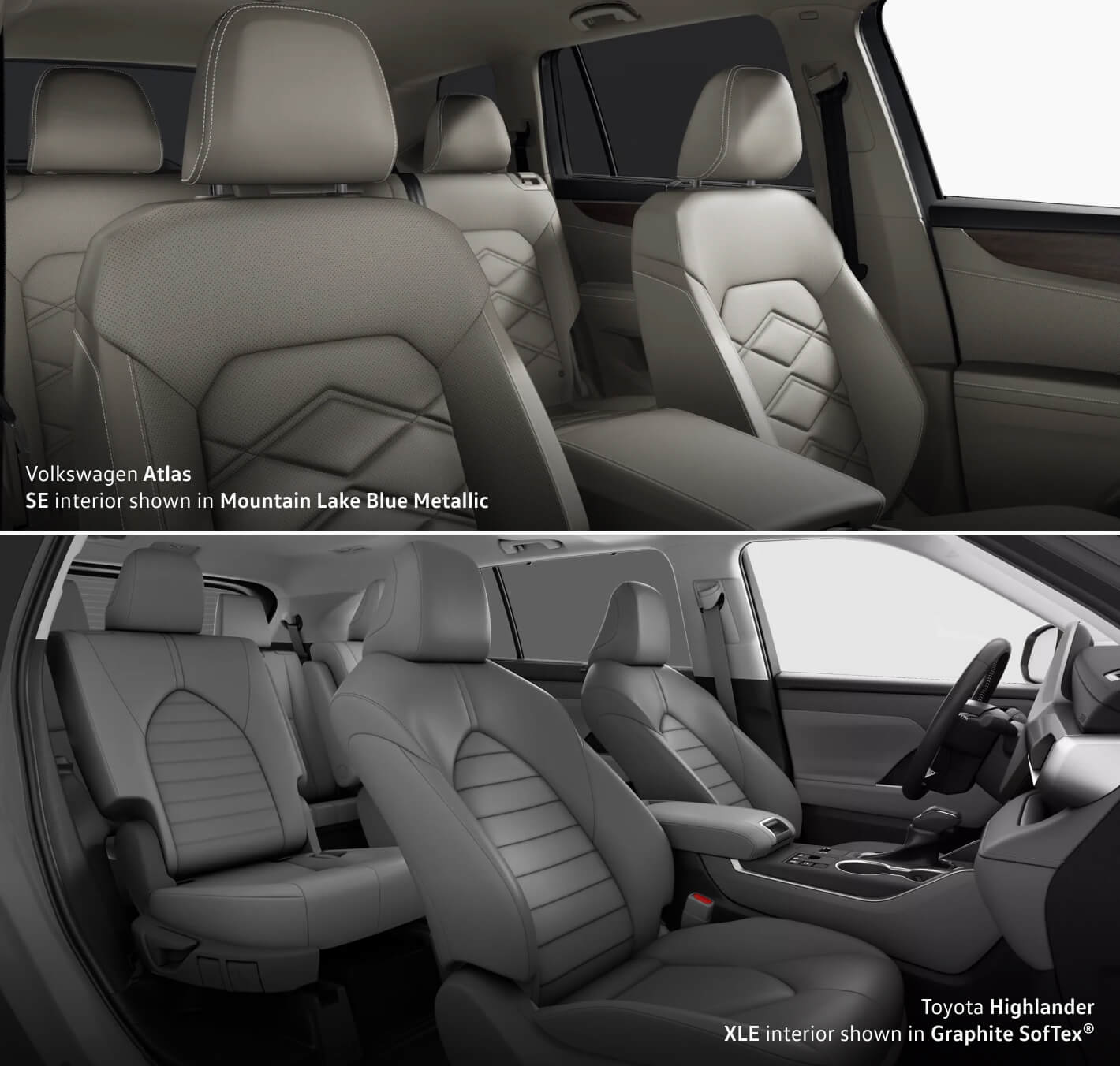
The Volkswagen SUV offers up to 153.7 cubic feet of passenger volume. With seats for up to seven passengers, this provides ample room for everyone to settle in and enjoy premium seating trim and other comfortable amenities.
On the other hand, the Highlander only offers up to 141.8 cubic feet of passenger space – more than 10 cubic feet less than what you can find in the Atlas. This may feel even tighter when you try to fill all eight seats available in some models. When it comes to traveling with a cabin full of friends or family, between the VW Atlas vs. Toyota Highlander interior, the former is clearly the better choice.
Third-row legroom is the perfect example: The VW Atlas gives the rearmost passengers 33.7 inches of legroom, while the Highlander offers a cramped 28 inches – almost 6 fewer inches, meaning many adults and teenagers won't enjoy themselves.
If you tend to haul more cargo than passengers, you may be wondering about the VW Atlas vs. Toyota Highlander cargo space. We have great news: the Atlas is the better option with a maximum cargo capacity of 96.6 cubic feet. By comparison, the Highlander only provides 84.3 cubic feet of cargo space with the rear rows folded down. With all the seats up, the Atlas wins again with 20.6 cubic feet behind the third row compared to the 16 cubic feet in the Highlander.
Want to see how the Volkswagen Atlas does against other rivals? Our VW Atlas vs. Kia Telluride pits our champion against another popular midsize SUV you may recognize.
Find Your Volkswagen Atlas at DARCARS Volkswagen of Fairfax
Comparing the Volkswagen Atlas vs. Toyota Highlander reveals that the Atlas is a powerful, spacious, and all-around top-tier midsize SUV that can serve you and your family for years to come. Finance one today at our dealership, or take advantage of our Atlas lease deals to experience the model without the long-term commitment.
If you're thinking pre-owned suits your goals better, explore our extensive selection of used VW Atlas models.
Frequently Asked Questions
What are the safety features of the Atlas 2025?
The Volkswagen Atlas comes with several safety and driver-assistive systems to keep you and your loved ones safe on the road. Features include:
- Travel Assist
- Adaptive Cruise Control
- Active Blind Spot Monitor
- Rear Traffic Alert
- Front Assist
- Emergency Assist
- Lane Assist
If you'd like to learn more about this safety suite, known as IQ.DRIVE, contact our team at DARCARS Volkswagen of Fairfax.
How often does the Volkswagen Atlas need oil changes?
As a general rule of thumb, you should schedule an oil change for your Volkswagen Atlas every 10,000 miles or one year, whichever comes first. Of course, this is just a suggested timeframe. It's always best to consult your owner's manual or reach out to the experts at our service center. We'll help you determine the optimal oil change schedule for your specific needs.
Which is bigger: the Toyota Highlander or the Volkswagen Atlas?
The VW Atlas is larger than the Highlander, inside and out. Specifically, the Atlas is 200.7 inches long, 78.3 inches wide, and 70.4 inches tall. The Toyota Highlander gets up to 197.4 inches long, 76 inches wide, and 98.1 inches tall. Because the Atlas is larger, it also provides more total passenger volume in the cabin, as well as a greater maximum cargo volume.
Featured Customer Review
Ashley Scott
1/11/2025

I worked with Jay and Emmanuel to purchase my new Volkswagen Atlas, and it is soooo beautiful. I love it! Their customer service and guidance throughout this experience were amazing. They were very knowledgeable, accommodating, and friendly. They made me feel comfortable, happy, and secure with my purchase. I truly appreciate this dealership and recommend it to anyone interested in purchasing a new car.
1Maximum tow rating when equipped with 2.0-liter four cylinder engine and factory-installed towing hitch. Vehicle load, other accessories, and options may reduce maximum towing capacity. See vehicle Owner's Manual for details.
2Before towing, confirm your vehicle and trailer are compatible, hooked up and loaded properly and that you have any necessary additional equipment. Do not exceed any Weight Ratings and follow all instructions in your Owner's Manual. The maximum you can tow depends on base curb weight plus the total weight of any cargo, occupants, and added vehicle equipment. "Added vehicle equipment" includes additional standard/optional equipment and accessories added by the manufacturer, dealers, and/or vehicle owners. The only way to be certain of your vehicle's exact curb weight is to weigh your vehicle without passengers or cargo. [Calculated with the new SAE J2807 method.] Installation of a tow hitch receiver or other accessories located near the rear bumper or side-door kick sensors may require disabling or removing the kick sensor, and the sensor operation setting in your vehicle should be turned off. See Owner's Manual for limitations.
320 city/26 highway mpg (2025 Atlas 2.0-liter four-cylinder turbo, eight-speed automatic). EPA estimates. Your mileage will vary and depends on several factors, including your driving habits and vehicle condition.
4Use for comparison purposes only. Your mileage will vary for many reasons, including your vehicle's condition and how/where you drive. See www.fueleconomy.gov.